BBCG ride to Woolwich v2
Sunday 22nd March 2026 10:15am
Starting from - We will meet outside Paddington Stations Elizabeth Line Station exit - What three words ///piper.safely.silly
For anyone getting the train, some of the group will be leaving Upton Court Park at 08:40 to catch the 9:15 train to Paddington. W2 1RH
, W2 1RH
This ride is limited to members of BBCG (Berkshire & Buckinghamshire Cycling Group) group only
- 18.7 miles
- Mountain Bike, Hybrid (off road tyres), Hybrid (road tyres), Road
- 4 hr
- Steady
- Westminster
- Children aged 8-15*, Children aged 11-15*, Adults 16+ only
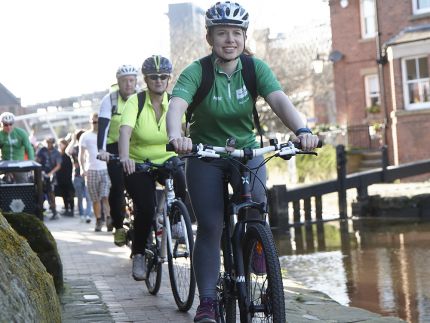
Led by experienced ride leaders, these rides are a great way to explore new places and to meet new people who enjoy cycling. They are suitable for all levels of experience, so whether you are a beginner or a seasoned cyclist, you can find a ride that is right for you.
Forgot password
Forgot password
Your details
Forgot password
Your details
About the route
Starting point
London
W2 1RH
The ride begins at Paddington Station, one of London’s great Victorian railway cathedrals, designed by Isambard Kingdom Brunel. Leaving the station you almost immediately slip into a quieter world of water and towpaths. Within minutes you reach Little Venice, where the Regent's Canal meets the Grand Union Canal. Narrowboats line the basin and cafés sit along the water; it is one of those London scenes that feels improbably tranquil considering the city around it.
From Little Venice the route follows the towpath east along Regent’s Canal. The canal itself dates from the early nineteenth century, part of the industrial logistics network that once fed London’s markets and factories. Today the atmosphere is completely different: runners, cyclists, houseboats, and the occasional heron standing like a bored philosopher at the water’s edge.
The path curves gently through Regent's Park and past the outer edge of London Zoo. From the canal you can sometimes glimpse animal enclosures—especially the aviary structures—an oddly surreal moment where urban cycling briefly intersects with wildlife conservation. The canal then continues through Camden and along long, leafy stretches where the city recedes behind the embankments.
Further east the route approaches the vibrant canal junction at Victoria Park, where you pause for lunch. Victoria Park is often called the “People’s Park,” opened in 1845 to give East Londoners access to green space during the industrial boom. Wide lawns, lakes, and café pavilions make it a natural stopping point after the canal section. In cycling terms it also acts as a hinge in the route: the calm canal journey transitions into the broader sweep toward the Thames.
After leaving the park the ride continues south-east through the East End, gradually shifting character from parkland to dense urban neighbourhoods and then toward the historic docklands area. The landscape here carries the ghosts of London’s maritime empire: shipyards, warehouses, and rail lines that once moved goods from the river inland.
Eventually the route reaches the Thames at Woolwich, where you take the historic Woolwich Ferry across the river. The ferry has operated in some form since the fourteenth century and today still carries vehicles, cyclists, and pedestrians between Woolwich and North Woolwich. After hours of following narrow canals and green corridors, the crossing opens suddenly onto the wide, tidal Thames—grey, powerful, and unmistakably maritime.
So the journey unfolds almost like a narrative of London itself:
Victorian rail gateway → peaceful canal basin → historic industrial waterway → royal parkland → East End communities → the working Thames.
The fascinating detail is that most of the distance follows infrastructure originally built for freight and industry. Canals that once carried coal and grain now carry cyclists and joggers. Cities evolve like ecosystems; the structures remain, but the purpose changes.
Route rating
(0) ReviewsRoute elevation
Who else is on this ride?
Ride leaders
-
Ride Leader

-
Community Groups Volunteer

Assistants
-
Ian Wiles
-
Ride Leader
-
Community Groups Volunteer
-

8 ride participants
-
Caspar Robinson
-
Paul Baker
-
Community Groups Volunteer
-
-
Eddie Bigus
-
Peter Jose
-
Jessica Shipp
-
Natalie English
-
Christopher Ward
-
Mustafa M Ramadan

Conversation
Register to join the conversation about this ride